Rights and boundaries to a plot of land: Know your limits

How to identify boundaries of a plot of land
If we are looking at buying a plot of land or we want to sell our land at any point, we need land borders to be clearly defined. It’s often when a land sale takes place that changes to boundaries come to light – but by then it may be too late to do anything about it. Perhaps the most contentious aspect of any land ownership is the exact extent of a plot and who has access to it.
Registered land ownership
Land registers are where a plot’s extent is recorded, but the real world is seldom like line drawings, plans and maps. HM Land Registry will tell you exactly who owns a piece of land, but the exact perimeter may still be up for discussion or heated debate. Fences are erected, walls are built and hedges and trees grow. Over time, the borders between properties can become blurred and the exact point where one starts and another ends can be difficult to see.
In England and Wales, often there’s no record of the exact boundary between neighbouring properties, or who owns a division such as a hedge, party wall, fence or tree (party walls are walls which you share with your neighbours in a terrace or semi-detached, but they can continue outwards to become boundary walls). Boundaries are set by the deeds of the property. You can contact the Land Registry to get the exact boundary determined, but if your neighbour disagrees with you on where it is, this can be an expensive and time-consuming process.
Pushing the boundaries
Usually, a change of land ownership will have to be done with a sale of the land. But there are instances when land ownership can change subtly, like when someone moves a fence when a new set of panels are fitted and pinches a few inches of land. If this is done blatantly, it can amount to a foot or a metre. And if you don’t complain – or even notice it, there may be plants for example obscuring it – for a period of time, they could then legally claim to be the owners and occupiers of the land. That’s when things get complicated, as you have to prove that the strip of land now on their side of the border used to be yours. A dispute of this kind can prove costly and often take years to resolve, which is no help if you are looking to sell your land in the interim.
Adverse possession
This type of land ownership is called ‘adverse possession’, where land is stealthily appropriated for longer than 10 years by someone other than its owner. It happens more often in rural areas, where boundaries are less clearly defined, and often happens when gardens border onto fields, hedgerows, heath or moorland, or parcels of woodland. The area at the bottom of the garden can become adopted as the landowner’s own – garden waste and grass cuttings might be dumped there, for example, which enables the perimeter to creep into the farmland. You sometimes see this type of encroachment on canals too, where narrow boats with more established moorings begin to set down roots on the riverbank, with the pitching of tables and chairs, etc. Eventually the encroachment becomes permanent and part of the landowner’s property.
Rights of way
Another challenge to land ownership can be with shared spaces and ones that grant rights of access. A shared garden or courtyard is everyone’s to use and so cannot be sold as part of a single property. Any owner would have to understand that outdoor space was a shared commodity. This includes shared driveways too.
Often a piece of land has a granted access to the public. People have a right to access land for walking, or certain other leisure activities. The public always have access to public roads and pavements (this includes narrow lanes and unnamed roads, if they are not private) or public rights of way, for example footpaths or bridleways. People can exercise their ‘right to roam’ on open access land, including mountains, moors, heaths, downs, common land and some land around the Coast Path too.
You can also access private land if the land used to be a public right of way in the past (you can check this on old maps and documents), the land has been accessed by the public for at least 20 years and nobody has asked them to stop, or the landowner has granted ‘permissive access’. Any access points will need to be clearly defined, so that access doesn’t become trespass. This will all need to be stated clearly however when the land is sold into new ownership and a professional land buyer will know what to do and where both buyers and sellers stand.
Any of these disputed or contentious aspects regarding land and boundaries can cause problems when it comes to selling a piece of land or a property with land around it. It’s always a good idea to appoint someone who knows the ins and outs of land sales and ownership. If you think the land you have has issues with its boundary or access, CB Homes can help with this. We are always on the lookout for suitable land to purchase – whether a small single plot, a large site or a redundant building with land around it. If you’d like guidance and advice on a land sale, then contact us today.
Latest posts
- 26th February 2025Planning for the future – Local Development Plans
- 5th February 2025On your doorstep – the importance of a site’s location
- 22nd January 2025Build, build, build – the importance of regeneration and housebuilding
- 9th January 2025Ettley Grove in Calveley: taking a closer look at the houses on our new development
- 19th December 2024Putting a roof on our multi-generational self-build home
- 12th December 2024Choosing Calveley for our latest development, Ettley Grove
- 28th November 2024The lie of the land – what types of land can you build on?
- 13th November 2024Our new development in Cheshire: total peace of mind when you buy from CB Homes
- 24th October 2024New build homes in Calveley, Cheshire – just launched!
- 24th October 2024Planning laws in England – what you need to know when you are selling land
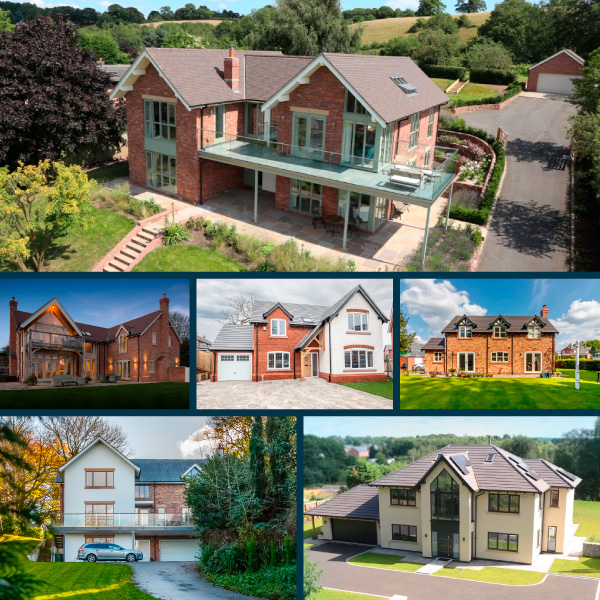
CB Homes Self-Build Projects
Get inspired with our range of past and current projects across a range of different house styles, requirements and budget.


