
SHORTLISTED UK house builder of the year – under 35 units
Month: January 2022
2021 – Build It Awards

SHORTLISTED Best Brick Home
2021 – Build It Awards
SHORTLISTED Best self-build under 250k
2021 – What House

WON Best luxury house Bronze award
How can your home help local wildlife?
This time of year, when it’s hard to imagine the warmer weather and longer days to come, is the perfect time to start planning ways in which your home and garden could enhance and protect local wildlife.

This time of year, when it’s hard to imagine the warmer weather and longer days to come, is the perfect time to start planning ways in which your home and garden could enhance and protect local wildlife.
Many planning applications for building projects are granted with conditions attached to ensure measures are taken to protect biodiversity. Many of our customers are keen to protect local wildlife when they can anyway and look on this as part of the attraction of building a home in the country, complete with a beautiful garden. We often fit bat and bird boxes to our new homes.
If you are starting to custom build a bespoke new house from scratch, with a little thought, it’s easy to build in protection and an enhanced environment for local wildlife right from the start. If you are happy in your current home, why not see what you can do to benefit the local birds, bees and other animal and plant life this year?
Going bats about bats
Many people would be astonished to learn that we have at least 17 species of bat breeding in the UK, which is almost a quarter of our native mammal species. From the largest – the greater mouse eared bat – to the smallest, the common pipistrelle, which only weighs as much as a 2p coin, bats are remarkable animals. To help support these amazing creatures, providing secure spaces for them to roost and breed is simple. Bat boxes are easy to install and come in a variety of shapes and sizes. Different ones are available for summer and winter use, some are designed with baby bats in mind and some are just a simple roosting space, suitable for a variety of different bat species. Find out more from the the Bat Conservation Trust.
Birdwatching could be a new hobby
Over lockdown, many of us discovered the simple pleasure to be found from watching nature literally on our doorstep, or at least just outside the window. There are 574 bird species to be found in the UK and while you are unlikely to see quite that many species in your garden, you will have a good chance of seeing at least 20 or so, especially if you do what you can to encourage them by providing somewhere safe to nest and feed.
Just like bat boxes, nest boxes are easy to install and again come in a variety of sizes. If you are tech-savvy and really want to maximise your birdwatching enjoyment, why not install a nest box camera and enjoy all the drama of a clutch of eggs hatching and baby birds being fed and learning to fly, all from the comfort of your armchair? Those of us who are less technically minded, will still get huge enjoyment just from feeding birds in our garden. Put up a simple bird table and make sure you keep it well stocked, especially in the colder months. Don’t forget to take part in this year’s Big Garden Bird Watch too.
Making a splash with a garden pond
A garden pond can form a delightful feature of your home.. Digging one from scratch can be quite a major undertaking. If you don’t want to go that far, any container of water will be appreciated by local wildlife needing somewhere to drink and splash. It will encourage newts, frogs and a whole host of insects to take up residence too. Make sure your ‘pond’ has a sloping side and some shallow water for the smallest visitors – even bees appreciate staying hydrated!
Bee helpful to local wildlife
Bees have featured in the news a lot recently as their numbers are plummeting. Planting a bee-friendly garden is one of the most positive projects you could start this year. There are a huge number of bee -friendly flowers and plants. Purple flowers are their favourite, but sunflowers, bluebells, salvias and cosmos are popular too. Rosemary and chives will attract scores of bees and will be useful in the kitchen too. If you like to grow your own vegetables, make sure you include onions, peppers and beans, as bees will particularly appreciate these. Overuse of pesticides is the main reason that bee numbers are in decline, so use natural products where you can.
Trees form an important part of landscaping around your home. Any fruit tree, especially apple and cherry will attract bees. So, if you are planning on including trees in your plans, try and add these into your design.
Home sweet home for wildlife too
You can easily make your own simple bee house or they are readily available in garden centres or on line. They should be constructed so the entrance points face downwards to let the bees get in and keep the rain out.
It’s always worth leaving a patch to grow wild in your garden if you have the space. Just letting one patch of grass grow long by mowing it less frequently will help support bees as it will give two of their favourite flowers, dandelions and clover, a chance to grow. Leaving a patch of longer grass also provides a hiding place for little mammals like wood mice, voles and shrews too. Find out more about creating a perfect wildlife garden here.
Get in touch with us today to find out how we can help you turn your self-building dream of a new home into reality.
Self-building a home in Cheshire, while living abroad
One reason why many of our self-build clients choose us to build their new home is because they are attracted by our turn key package, where we manage every aspect of the build on their behalf. One of our current self-build projects is quite unusual, as our clients chose our turn key package as their preferred option because they are currently living abroad. Until recently they were unable even to visit the site of their new home.
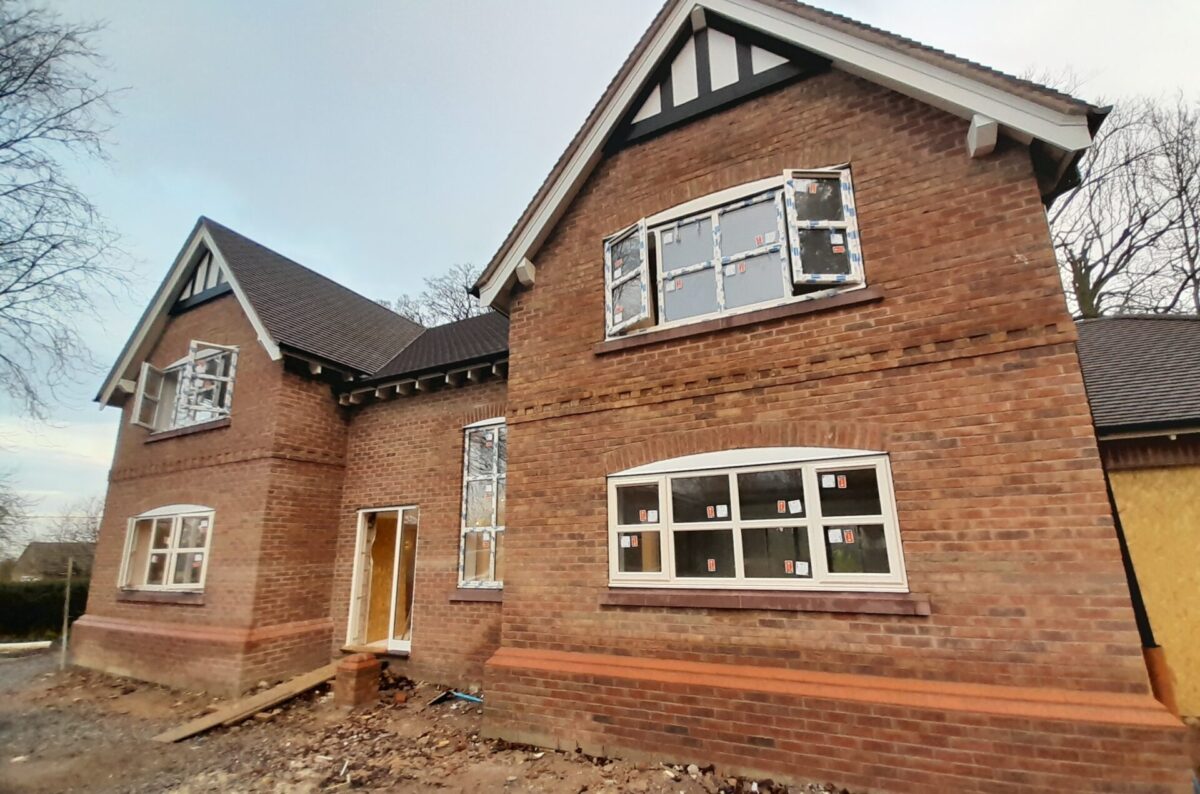
One reason why many of our self-build clients choose us to build their new home is because they are attracted by our turnkey self-build package, where we manage every aspect of the build on their behalf. One of our current self-build projects is quite unusual, as our clients chose our turn key package as their preferred option because they are currently living abroad. Until recently they were unable even to visit the site of their new home.
No strangers to the self-build process, Kevin and Sandra built their own house in Hampshire some time ago. Then they moved to Portugal and once more built their own home, with Kevin taking responsibility for a large part of the build himself.
When they decided they wanted to have a home in the UK once more, they decided the most stress-free option was to opt for CB Homes’ turnkey self-build package. This turned out to be a particularly fortunate decision as, once Covid hit, travel restrictions meant they could not visit the UK so had to rely on the CB Homes team and modern technology to keep up to date on the build’s progress. Luckily, CB Homes is well set up for online meetings via Zoom or for conference calls, which is very useful for clients leading busy lives, whether living abroad or not.
Why choose Cheshire for a self-build project?
Kevin has been a Manchester United FC season ticket holder for years, so having a base within easy reach of Old Trafford had huge appeal for him. Sandra is originally from Yorkshire, so having a home in the North West was also an attraction for her. The close proximity of two airports, the motorway network and the cities of Chester, Liverpool and Manchester also made Cheshire the ideal location, with friends and family in easy reach.
Why build your own house?
In common with most of our self-build clients, Kevin and Sandra recognised that the best way to end up with exactly what you want from a house is to build it yourself. They also both say that they enjoy the process of a self-build and find it very interesting – even if they can currently only observe from a distance, thanks to the pandemic.
Finding a plot of land for a self-build, while living abroad
In today’s market, finding land for a self-build can be challenging. After extensive online searching for a suitable plot, Kevin and Sandra bought a plot of land from CB Homes – a garden plot in the grounds of another house, which already had planning permission for a traditionally designed typical English home, with plenty of modern touches inside. The five-bedroom house will also have a detached garage and enjoys an elevated position, with views across the Cheshire plain.
The new house currently being built by CB Homes in the village of Helsby is currently at the first fix stage with the electrics and plumbing being installed and plastering taking place on the first floor. Normally at this stage, our clients would walk through the property with the site team, pointing out exactly where every power point or appliance would go. In this case, as they are living abroad, Kevin and Sandra have used the power of WhatsApp and email to communicate exactly what they want and where they want it.
Which part of the house will our clients be most excited to see?
Sandra is particularly looking forward to seeing her new kitchen, which will be part of an open plan living/ dining/ family space. Making selections from such a distance has been a challenge, but she has sent samples, where she can, to trusted family members, who have given their opinions to help her make a choice. She admits she has still spent many hours looking at carpet and paint shades online though!
What impact has Covid had on the self-build project?
In addition to making it impossible to visit the site for months at a time, due to living abroad, the pandemic has also caused some delays to appliance deliveries, with some manufacturers needing much longer lead times than usual. This has meant CB Homes has had to adjust the build schedule accordingly in order to keep the delivery date on track.
Managing the budget for a self-build
Kevin and Sandra say that the budget has been exactly as they expected and are definitely fans of CB Homes’ very clear pricing structure.
Sandra says, “You have a great choice of layout and fittings but if you want to choose more expensive options than in CB Homes’ specification, then you’re free to do so. It’s just really important to set your budget for that and then to stick to it.”
Summing up her advice to anyone considering a self-build, she says, “Choose your plot really carefully and then just go for it. CB Homes has been excellent at guiding us through the process and offering advice and suggestions on anything that we have not been sure of, from queries on acquiring land to making decisions on bathroom fixtures and fittings. The team is always very responsive to any questions we have.”
Kevin and Sandra hope to be in their house by February.
Have you always dreamed of building your own home? Have you got a plot of land suitable for building on? Contact CB Homes today to find out how we can help you.


