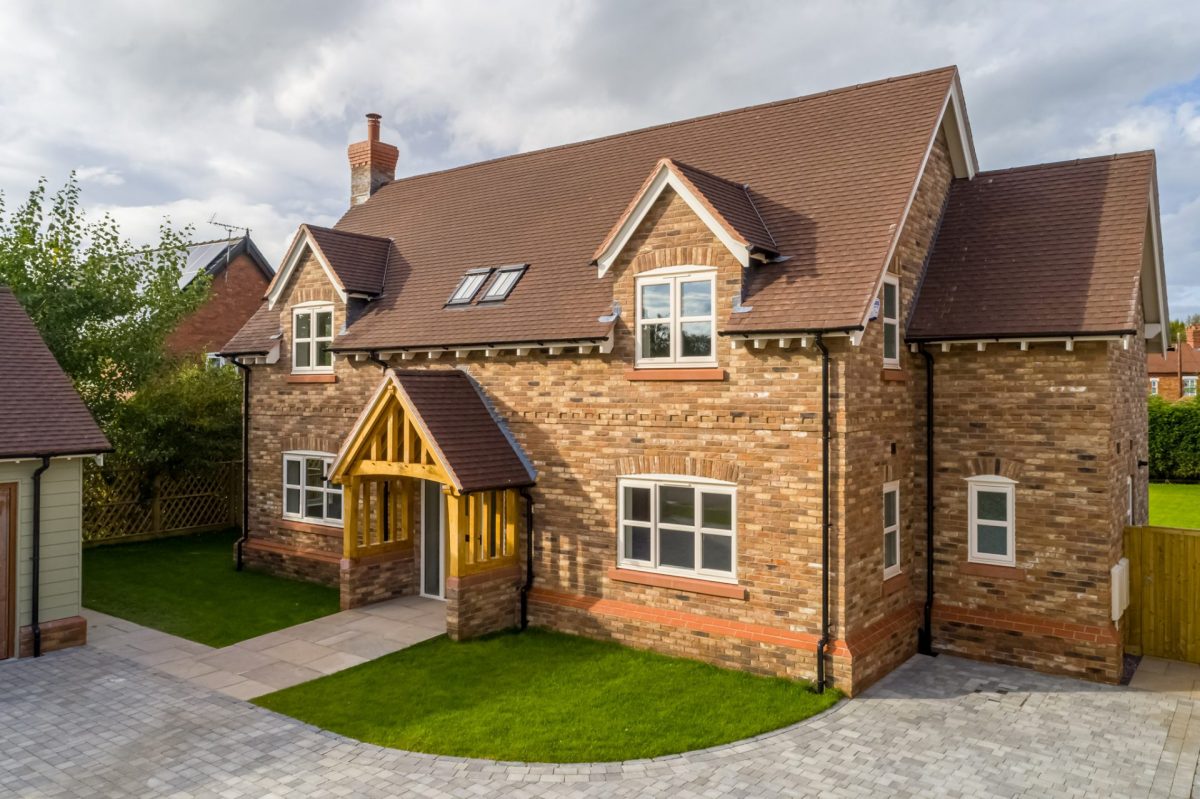
Planning Policy is something that will impact your self-build project from an early stage. It’s a tricky area. An understanding of the basic principles will enable you to determine quickly whether a potential plot is viable for planning. If you are unsure about aspects of planning policy, it’s worth seeking professional advice from experts who will be dealing the processes and applications on a daily basis.
The National Planning Policy Framework
The National Planning Policy Framework (NPPF) was initially published on 27 March 2012 and was further revised on 24 July 2018. In its original incarnation the NPPF comprised over two dozen different documents called Planning Policy Statements (PPS) and Planning Policy Guidance Notes (PPG), all compiled into one document.
Over 1300 pages have been condensed into a 65-page document and a 27-page Technical Guidance document. It sets out the government’s planning policies for England and how they are applied. The NPPF outlines a framework within which locally-prepared plans for housing and other developments can be produced. It has to be considered when preparing the development plan and should be included in planning decisions.
Local Council Plans
At a more parochial level, Local Council Plans are local plans prepared by the Local Planning Authority in conjunction with the NPPF. They set out their vision for the future of each area and a framework for addressing housing needs and other economic, social and environmental priorities. The requirements of each area will be different, but in more and more cases developments in the countryside are being permitted on a larger scale, as the need for more housing has become a major issue. Idle land – for example former farmland – is being utilised for this, while in cities former industrial or other areas, referred to as brownfield sites, are also being developed.
Neighbourhood Plans
These have become particularly important for developments in villages and towns and consider the population, the parish boundaries and the needs and desires of the local people. They assess the amenities that are already present and the ones that may be needed with future growth. They are plans developed by neighbourhoods or communities where they can set out their vision for their neighbourhood and how they see future development happening in their area. These plans have to be created in line with the Local Plan and NPPF. If adopted, they form part of the Local Plan. They enable local communities to have a much stronger say in the future shape of their community.
When you are searching for a plot, it’s very useful to understand which Local Planning Authority (LPA) and neighbourhood boundary it falls under and if they have a Local Plan and/or Neighbourhood Plan in place. These should be available online on local council websites and even though they are hefty documents, it’s worth reading the main points in summary, in order to understand the development framework in place for that area.
It’s also worth considering the following key aspects of planning policy when plot searching and bear them in mind when identifying a suitable location – though they may not apply in all LPAs.
Where is development focused?
For the majority of Local Plans, development is focused in urban areas. This is where the majority of a region’s resources – jobs, services, amenities, facilities etc – are based. Increasingly, some Local Authorities are allowing more development in smaller towns and villages. Is your plot in an area which promotes development?
Settlement boundaries
Depending on the area’s classification, it may have a settlement boundary. These boundaries determine where towns and villages end, and where the countryside begins. Development is likely to be more feasible if the plot is within these settlement boundaries. However this is not always the case in some smaller villages and boundaries can change over time, to broaden the potential for development.
Infill development
In the majority of cases, infill development is classed as a ‘small gap or space in an otherwise built-up road frontage’ which could allow the construction of one or two houses. Keep on the lookout for these opportunities in towns and villages, but be aware that not all these gaps are available for development, as whether it is defined as infill depends on certain criteria and the location.
Replacement dwellings
These are becoming increasingly popular in areas where land prices are high. They entail demolishing the existing property on the site and rebuilding a new one. However, there could be restrictions in conservation areas or for listed buildings. It is also important to note that in many cases, you cannot build a larger dwelling and any newbuild has to be in keeping with the surrounding properties.
Barns
Depending on the structure and the location of the barn, it may be possible to convert or re-build to a habitable dwelling, but some LPAs are now restricting these in current Local Plans.
Brownfield land
This is land which has previously been developed and is not currently in use. Many LPAs actively promote the re-use of brownfield land for development, as in some cases there will be existing infrastructure or services onsite. Depending on its location, however, there may still be restrictions on development. It is also worth checking whether there is any contamination.
All this information is useful to assess the viability of sites for development. Each site presents its own unique characteristics and we therefore always recommend getting sites appraised by professionals, who are fully compliant with current polices.
CB Homes offers FREE planning advice, so please get in touch today to find your perfect plot.